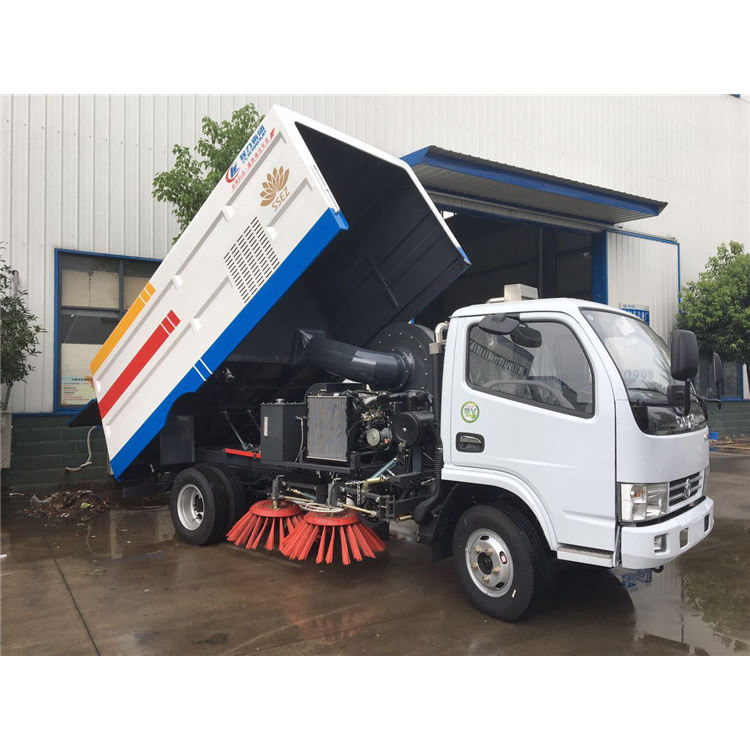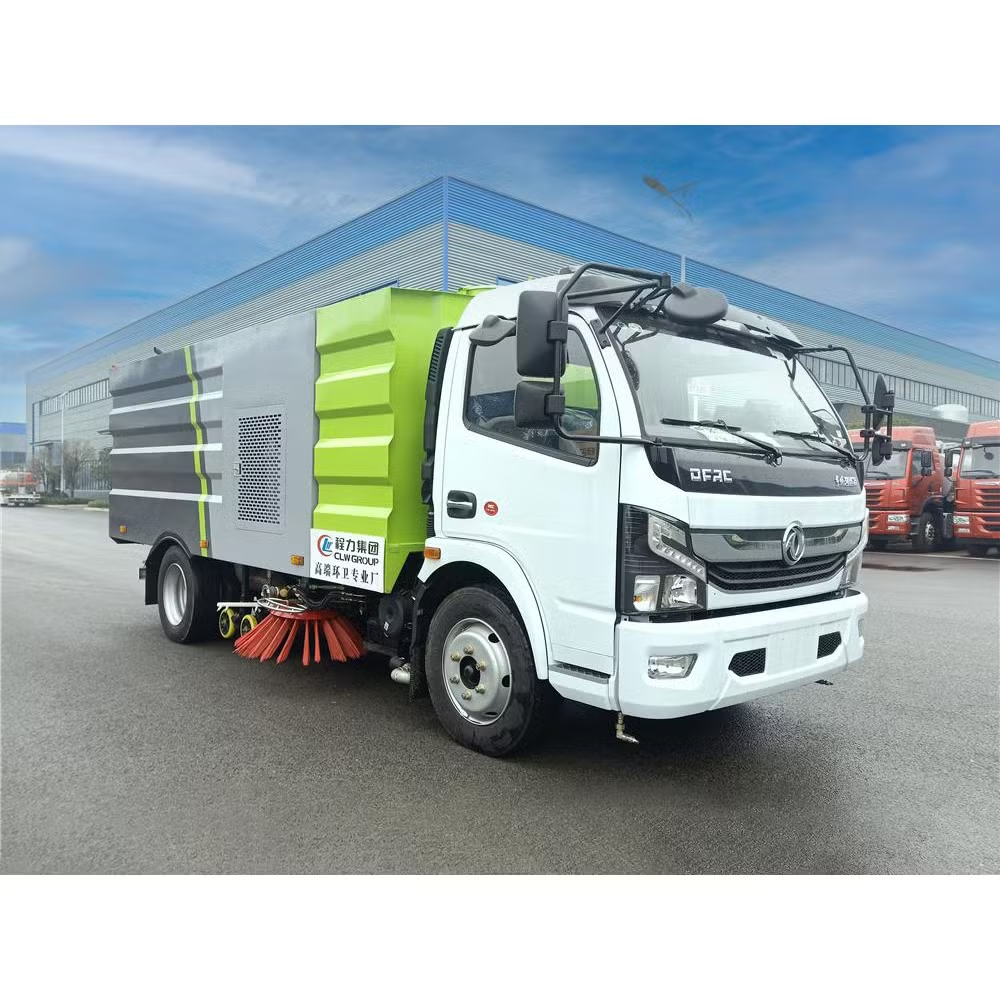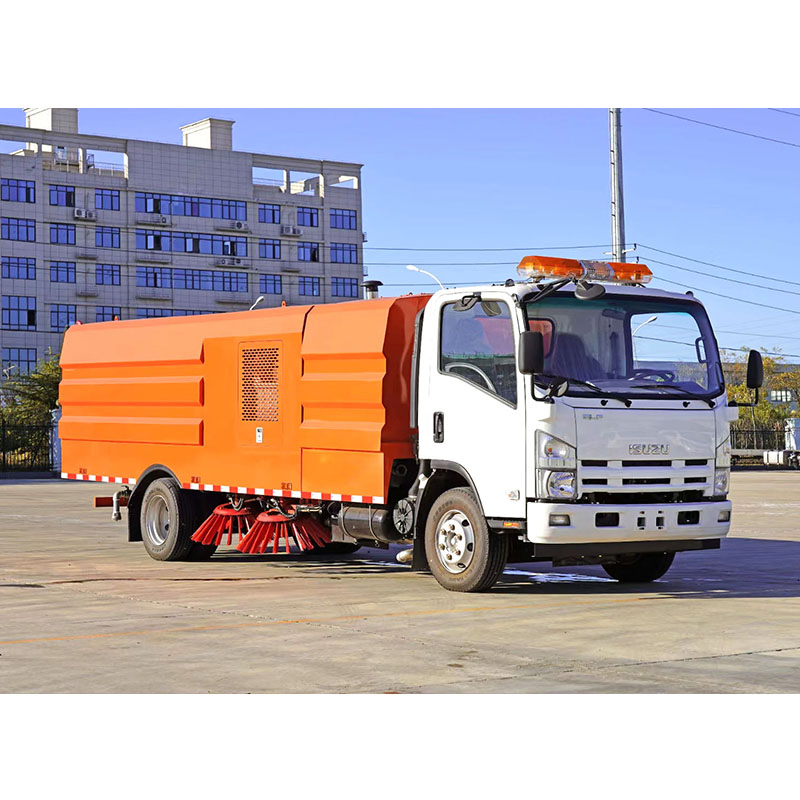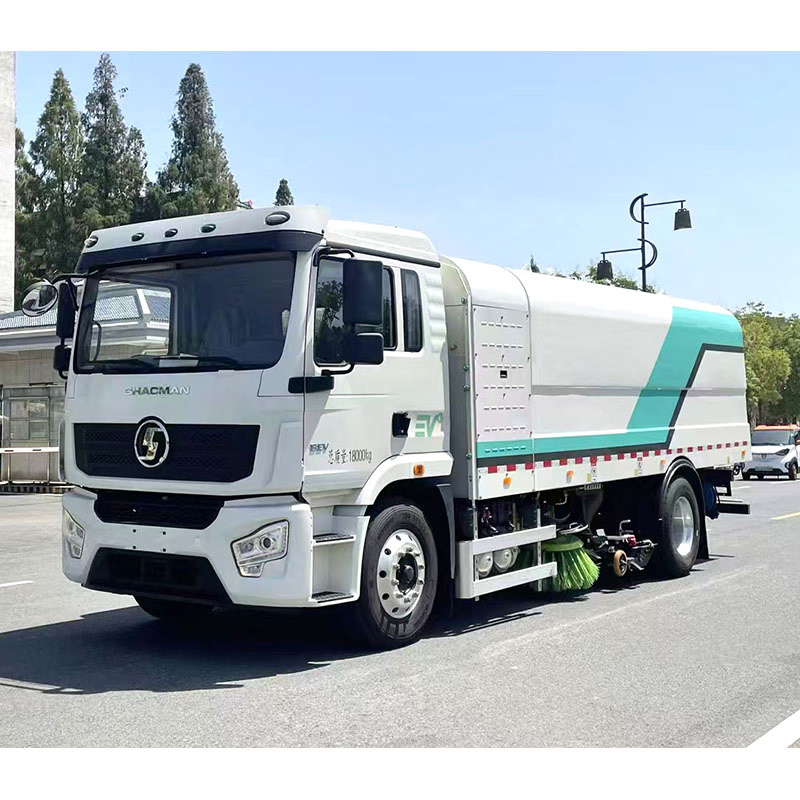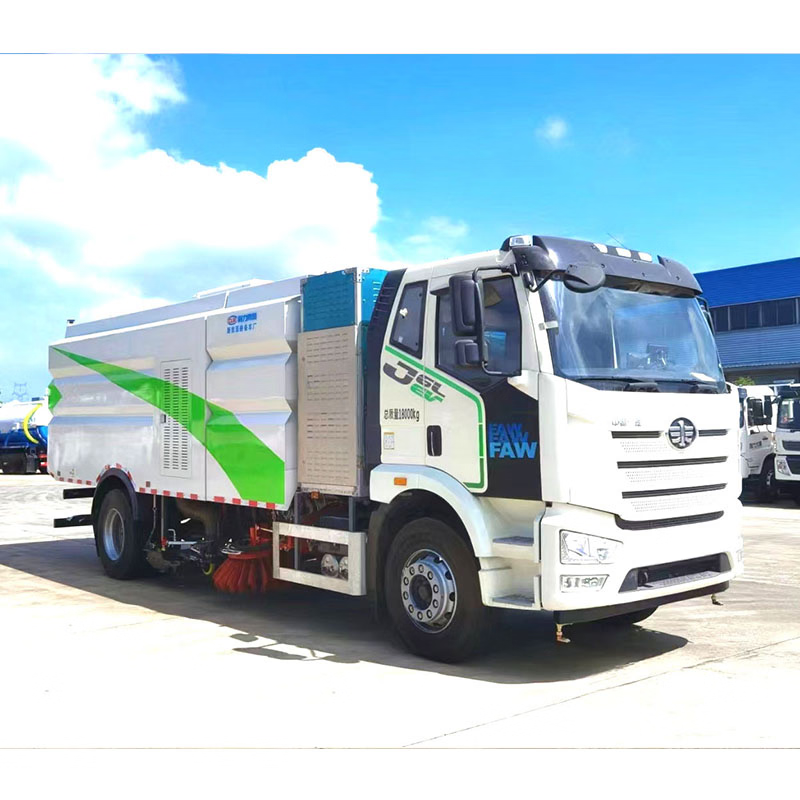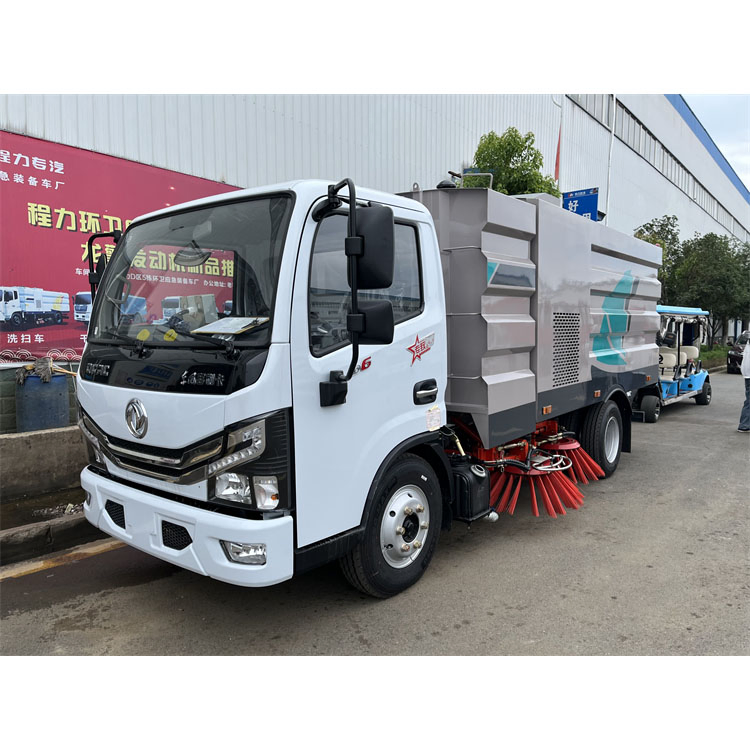
For town streets, estates and yards, choose a 4x2 road sweeper with a 3.5 to 5 m³ dustbin. For highways, ports and airports, choose an 18 ton class or 6x4 sweeper with a 7 m³ dustbin. Pick sweep and suction for dry dust and sand. Pick wash and sweep where mud and oil marks must go. Then confirm the bin, water tank, engine and drive side in the written quotation.
How a vacuum road sweeper works
A vacuum road sweeper is a truck with brushes, a suction system and a closed bin. It cleans as it drives slowly along the kerb. The larger trucks in our road sweepers range work at 5 to 20 km/h.
- Side brushes sit at the front corners. They sweep dirt out of the kerb line and push it towards the middle of the truck.
- The suction nozzle is a wide mouth under the truck. On the 18 ton Dongfeng washer it is 2,200 mm wide.
- The fan makes the suction. It pulls dirt, sand and litter up through the nozzle and into the bin.
- The dustbin is the closed body that holds the dirt. It tips up to empty at the dump site.
- The water spray wets the dust near the brushes. This keeps the air clear for the crew and other road users.
The fan and brushes need power. On the 6x4 truck, a separate 170 hp Cummins auxiliary engine drives them. Sweeping power then does not change with road speed. On other trucks, ask how the fan is driven and how much power it gets.
Who buys a road sweeper
City and town councils use sweepers on main streets, markets and bus parks. Road contractors and road agencies clear sand and gravel from highways after storms. Airports sweep runways, taxiways and aprons, because loose stones can damage aircraft engines. Ports clean container yards, and industrial zones keep their roads free of dust. Mines and cement plants clean their access roads.
Choose the size for your roads
A bigger dustbin means fewer trips to empty it. A bigger truck is also harder to drive in narrow streets and under low trees. Match the size to your longest route and your narrowest gate.
| Work | Suitable sweeper | Example size |
|---|---|---|
| Side streets, estates, campuses and factory yards | Small 4x2, GVW (gross vehicle weight: the truck plus its full load) 7,360 kg | 3.5 to 4.2 m³ bin, 1.2 to 2 m³ water tank |
| Town main streets, market roads and industrial parks | 12 ton class 4x2 | 5 m³ bin and 4 m³ water tank on the Dolica, 2,200 to 2,350 mm wide |
| City main roads, ring roads and bridge decks | 18 ton class 4x2 | 7 m³ bin on the washer, 2.8 to 3.5 m cleaning width |
| Highways, airports, ports and long routes | 6x4, GVW 25,000 kg | 7 m³ bin, 9,000 L water tank |
The 4.2 m³ Dongfeng truck has a large bin and a small 1.2 m³ water tank. It suits dry, sandy roads with a lot of loose dirt. On most 12 ton and 18 ton sweep and suction trucks, the bin and tank sizes depend on the final build. Ask for them in writing.
The water tank sets how long the crew can work before refilling. A 9,000 L tank suits long highway shifts. A 2 m³ tank suits short town routes with a water point nearby.
Sweep only or wash and sweep
A sweep and suction truck uses brushes, suction and a light cold water spray. It is the simpler choice for dust, sand, leaves and litter. It uses less water, which matters where water points are far apart.
A wash and sweep truck adds spray bars and a high-pressure pump. The Dongfeng 18 ton washer works at 27 MPa with a 92 L/min pump. It removes mud and oil marks that brushes alone leave behind. It can also wash road barriers and kerbs. It needs a steady water supply, and the pump and nozzles need more care. If you already sweep with another truck, a water bowser can do simple street washing.
What to confirm in the quotation
- Dustbin: volume in m³, material and tipping angle.
- Water tank: clean water volume, and the filter tank volume on a washing truck.
- Sweeping kit: number and size of brushes, suction nozzle width and working width.
- Fan drive: auxiliary engine brand and power, or how the main engine drives the fan.
- Main engine: power and emission level. Euro 6 and Euro VI engines need clean, low-sulphur diesel.
- Drive side: LHD (left-hand drive) or RHD (right-hand drive). See drive side by country.
- Spares: spare brushes, filters and nozzles to ship with the truck.
Recommended trucks
The price is the listed reference price (FOB China, ex-factory list), and the written quotation fixes the final price. For all sizes and prices, read the road sweeper truck price guide.
- Dongfeng 4x2 Road Sweeper Truck, 3.5 m³ Dustbin, 2 m³ Water Tank, 136 hp: for estates, campuses and factory yards, US$24,500-25,500.
- Dongfeng 4x2 Road Sweeper Truck, 4.2 m³ Dustbin, 1.2 m³ Water Tank, 82 hp: for dry, sandy town roads, US$26,500-27,500.
- Dongfeng Dolica 4x2 Wash and Sweep Truck, 5 m³ Dustbin, 4 m³ Water Tank: sweeps and washes town streets, US$24,850-29,880.
- Qingling Isuzu 4x2 Road Sweeper Truck, 12 Ton Class, 130 hp, Sweep and Suction: for town councils and industrial estates, US$33,300-34,800.
- Shacman 4x2 Road Sweeper Truck, 18 Ton Class, 210 hp Yuchai, Sweep and Suction: for ring roads and mine access roads, US$51,800-53,800.
- FAW Jiefang 4x2 Road Sweeper Truck, 18 Ton Class, 220 hp, Sweep and Suction: for main roads and container yards, US$56,800-58,800.
- Dongfeng 4x2 Road Sweeper and Washer, 18 Ton, 7 m³ Dustbin, 230 hp: sweeps and washes main roads and tunnels, US$53,000-65,000.
- Dongfeng 6x4 Road Sweeper Truck, 7 m³ Dustbin, 9,000 L Water Tank, 25 t GVW: for highways, airports and long routes, US$64,500-65,800.
Before you order, read importing a truck from China to Africa. Councils that also collect waste can compare refuse trucks. When you are ready, see how to buy or contact us.