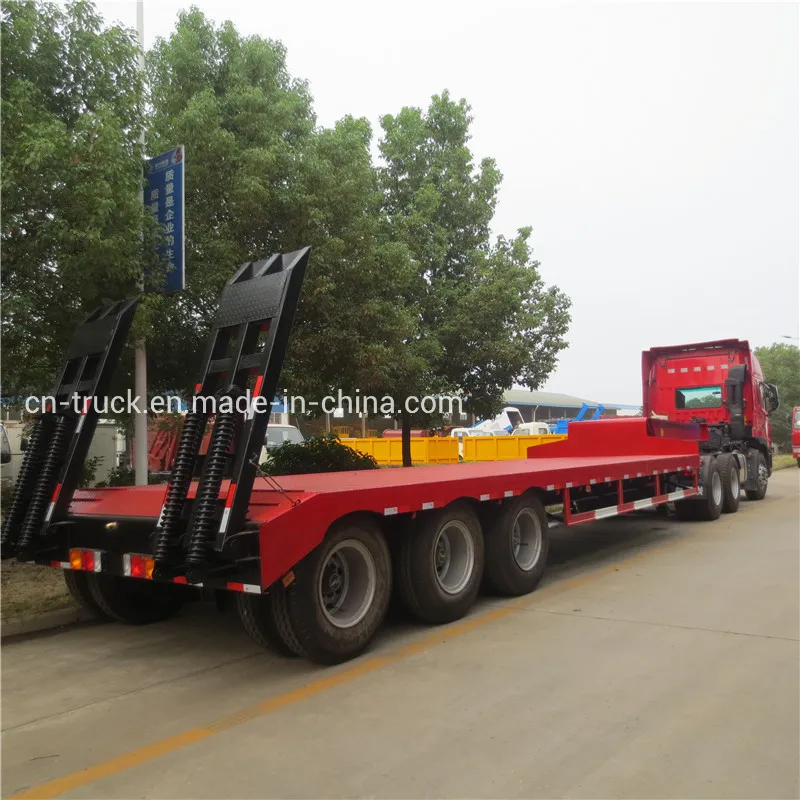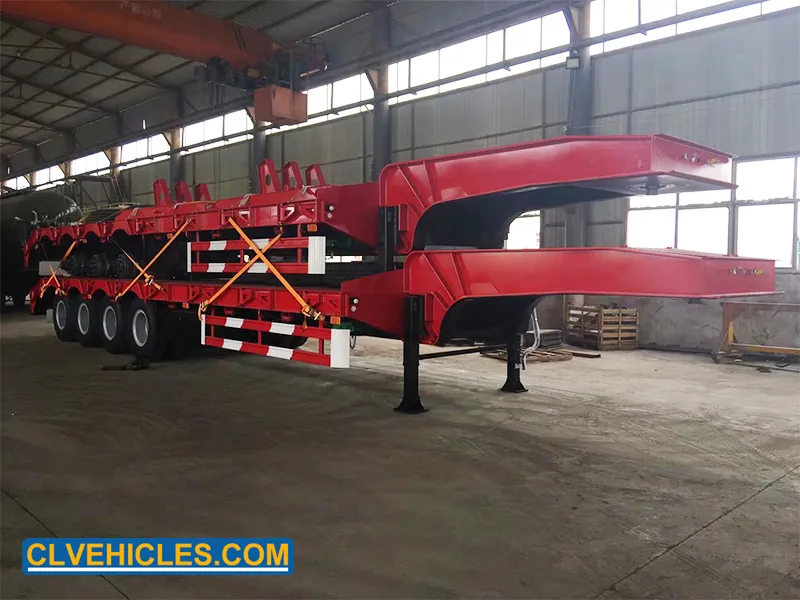
A lowbed trailer (also called a low loader, low bed or lowboy) is a semi-trailer with a deck set low to the ground. The low deck keeps a tall machine such as an excavator or a dozer under bridge and power line heights, and lets it drive on and off over ramps. Plant hire firms, road contractors and mines use lowbeds to move their machines between sites.
This guide explains how to choose the number of axles, the deck and ramps, and the prime mover to pull it.
1. Start with the heaviest machine you will move
Write down the operating weight, width and height of the heaviest machine. Rough operating weights:
- Backhoe loader: about 8 to 9 tonnes
- Motor grader: about 14 to 20 tonnes
- 20 tonne class excavator: about 20 to 23 tonnes
- 30 tonne class excavator: about 28 to 32 tonnes
- Medium dozer (D6 class): about 18 to 23 tonnes; large dozer (D8 class): about 38 tonnes or more
Add a margin for buckets, blades and attachments. The trailer's rated load must be higher than the machine weight, and the total weight of prime mover, trailer and machine must stay inside the limits of your roads.
2. Three axles or four axles?
- 3-axle lowbed: the common choice for machines up to about 30 to 40 tonnes, such as 20 tonne excavators, graders and medium dozers. It is lighter, cheaper and easier to turn. Example: the CLW 3-axle lowbed with a 13 m deck and 500 mm main beams on BPW 14 tonne axles (US$8,600-15,000).
- 4-axle lowbed: for heavier machines in the 50 to 70 tonne class, such as large excavators and big dozers. More axles spread the weight, which helps with axle load limits and bridge rules. Example: the CLW 4-axle 70 tonne hydraulic lowbed (see the product page for the reference price).
For machines heavier than about 70 tonnes, ask about multi-axle or modular trailers, which are specialist builds.
3. Deck height, length and width
- Deck height: a lower main deck gives more clearance under bridges. Check the machine height plus the deck height against the lowest bridge or power line on your route.
- Deck length: make sure the machine's tracks or wheels sit fully on the main deck, with room for the boom or blade.
- Width: the standard width is about 2.5 metres. Many large machines are wider than this, which usually makes the load an abnormal load in law.
- Gooseneck: the raised front section carries the kingpin over the prime mover. Some lowbeds have a detachable gooseneck so machines can drive on from the front.
4. Ramps: mechanical or hydraulic
Most lowbeds load from the rear over ramps. Mechanical (spring-assisted) ramps are simple and cheap but heavy to lift by hand. Hydraulic ramps are raised and lowered by a pump, which is faster and safer for the crew, and they are worth it if you load every day. Ask for the ramp length and angle, because a steep ramp can catch low machines.
5. Axles, tyres and suspension
- Axle make and rating, for example BPW or Fuwa 13 to 14 tonne axles.
- Tyre size and number; 11.00R20 or 12R22.5 tyres are common and easy to replace in Africa.
- Mechanical leaf spring suspension is standard and easy to repair on rough roads.
- ABS brakes are optional on many trailers but required in some countries.
- Kingpin size: 3.5 inch kingpins are normal for heavy lowbeds; check that it fits your prime mover's fifth wheel.
6. Match the prime mover
A loaded lowbed needs a strong 6x4 prime mover (horse) with enough power and a heavy-duty fifth wheel. For machines up to about 40 tonnes, 380 to 430 hp is usual; heavier loads and steep routes need more. Options on this site include the Sinotruk HOWO 6x4 prime mover, 430 hp (US$43,500) and the Dongfeng 6x4 truck tractor, 420 hp (US$28,620-38,600). The prime mover and semi-trailer buying guide explains how to match the two.
7. Permits and safety
Many machine moves count as abnormal loads because of their width, height or weight. In South Africa, Kenya, Tanzania, Zambia and other countries, an abnormal load usually needs a permit, and sometimes an escort vehicle and set travel times. Check the rules with your road authority before you buy, because they affect which trailer size makes sense. On every load, chain the machine down at the points the maker specifies and lower the boom or blade.
Prices and next steps
Prices are reference prices (FOB China, ex-factory). The final price depends on the number of axles, deck size, ramps, axle and tyre brand and options, and is fixed in a written quotation. See the semi-trailer and prime mover price guide, browse all semi-trailers and prime movers, and send us the weight, width and height of your heaviest machine through the contact page.